
GEO Citation Funnel: Why 90% of Content Fails Before Reaching AI Recommendations
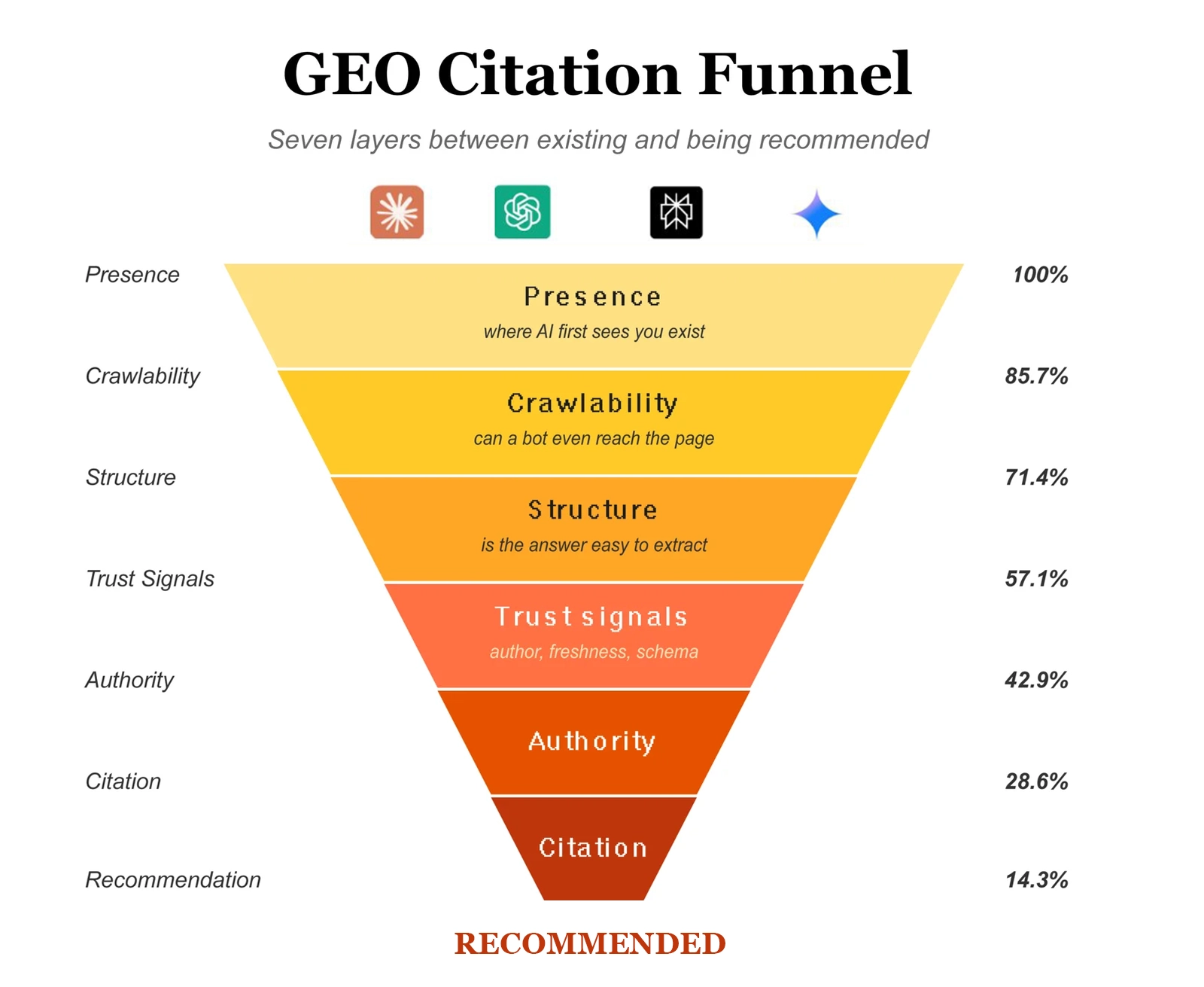
Most Generative Engine Optimization (GEO) strategies reduce success to a single goal; get cited. However, focusing purely on citation optimization addresses only the final step of a much longer digital pipeline. According to Cloudflare data, only 10% of AI crawler traffic is search-oriented, the remaining 90% is pure extraction, content harvested with zero attribution attached.
By the time an AI engine considers citing your brand, you have already lost over 70% of your potential visibility. Winning in AI-driven search requires optimizing for the entire seven-layer survival funnel content must navigate before ever making it into a final user response.
The 7-Layer GEO Citation Funnel
Every layer in the GEO funnel acts as a strict filter. Weakness in an upper layer creates an unyielding ceiling on what downstream optimizations can achieve, perfect authority signals mean nothing if an AI crawler was blocked from reading your page in the first place.
Why Upstream Fixes Matter Most
Optimizing for citations without auditing your technical foundation is a waste of resources. To fix your GEO pipeline, evaluate your content architecture against three core bottlenecks:
✓ Eliminate Crawl Barriers: Ensure your CDN or web application firewall (WAF) isn't aggressively blocking legitimate AI scraping agents. If bots drop off at Layer 2, your downstream content authority is irrelevant.
✓ Format for Machine Extraction: AI models prioritize content with low parsing friction. Replace dense, conversational prose with structured bullet points, clear definitions, and standardized table schemas.
✓ Build Consensus Outside Your Site: Authority in GEO relies heavily on third-party verification. Search engines and LLMs cross-reference your claims against external databases and industry publications to confirm factual reliability before recommending your brand.
Moving beyond simple citation hunting to systematically auditing every layer of the GEO funnel ensures your content survives the extraction phase and lands directly in front of the user.